
King County Court Records After Arrest
The arrest-to-court pathway has several record systems. DAJD booking records start when a person is arrested, transported, identified, fingerprinted, assigned a B/A number, and admitted to detention. DAJD states that Adult and Juvenile Detention does not provide court case or hearing information. Formal King County court records after a jail arrest are handled through the courts once the prosecutor files charges.
For custody, booking time, B/A number, and jail location, use King County jail inmate records. For booking photos and the limits on public photo release, use King County jail mugshots. For charges, hearing dates, case status, warrants, and dispositions, search court records. The booking charge can be an investigation label. The court charge is the accusation filed into a case.
King County's Department of Public Defense notes that families may use DAJD lookup to find booking time, what the person is being investigated for, and whether bail has been set. That is useful starting data, but court records after an arrest require court portals, clerk access, or direct contact with the court that filed the case.
Who Files King County Charges
Washington counties use prosecuting attorneys, not district attorneys. In King County, the filing office is the King County Prosecuting Attorney's Office. The official PAO page identifies Prosecuting Attorney Leesa Manion, a main phone number of 206-477-1200, and the courthouse address at 516 Third Avenue, W400, Seattle, WA 98104. The Mainstream Criminal Division represents the state and county in criminal matters in District Court, Superior Court, appellate courts, and higher state and federal courts.
After a jail arrest, police reports and probable-cause materials go to prosecutors. The prosecutor may file the same offense described at booking, file a different offense, reduce or amend the charge, decline to file, or later dismiss. That is why court records after a jail arrest often differ from the early jail record. A booking record can point to the right person and date, while the court record shows the charge that entered the legal case.
King County Prosecuting Attorney
King County Courthouse
516 Third Avenue, W400
Seattle, WA 98104
206-477-1200
prosecuting.attorney@kingcounty.gov
Mainstream Criminal Division
Seattle: 206-296-9000
Kent: 206-205-7400
District Court Units
Seattle-West 206-477-1290; MRJC-South 206-477-2060; Redmond-East 206-477-3150.
Search Court Records After Arrest
There is no single King County court-records-after-arrest database that replaces every court. The statewide Washington Courts Search Case Records and Find My Court Date portal can point to municipal, district, superior, and appellate cases, but it warns that complete records must come from the filing court. King County Superior Court documents and many records are accessed through Superior Court Clerk records access and KC Script. District Court criminal and infraction searches use the King County District Court case access portal.
- Use DAJD Subject Lookup first if the case number is unknown. Record the exact booking name, booking date, and B/A number.
- Search Washington Courts by name, date of birth, case number, or court date to identify the filing court.
- Use King County District Court search for misdemeanor, infraction, or district-level matters.
- Use Superior Court Clerk records access or KC Script for felony and superior-court records.
- Compare booking allegations to filed court charges, then check status, next hearing, and disposition.
The statewide court search source appears in the official Washington Courts case search portal.
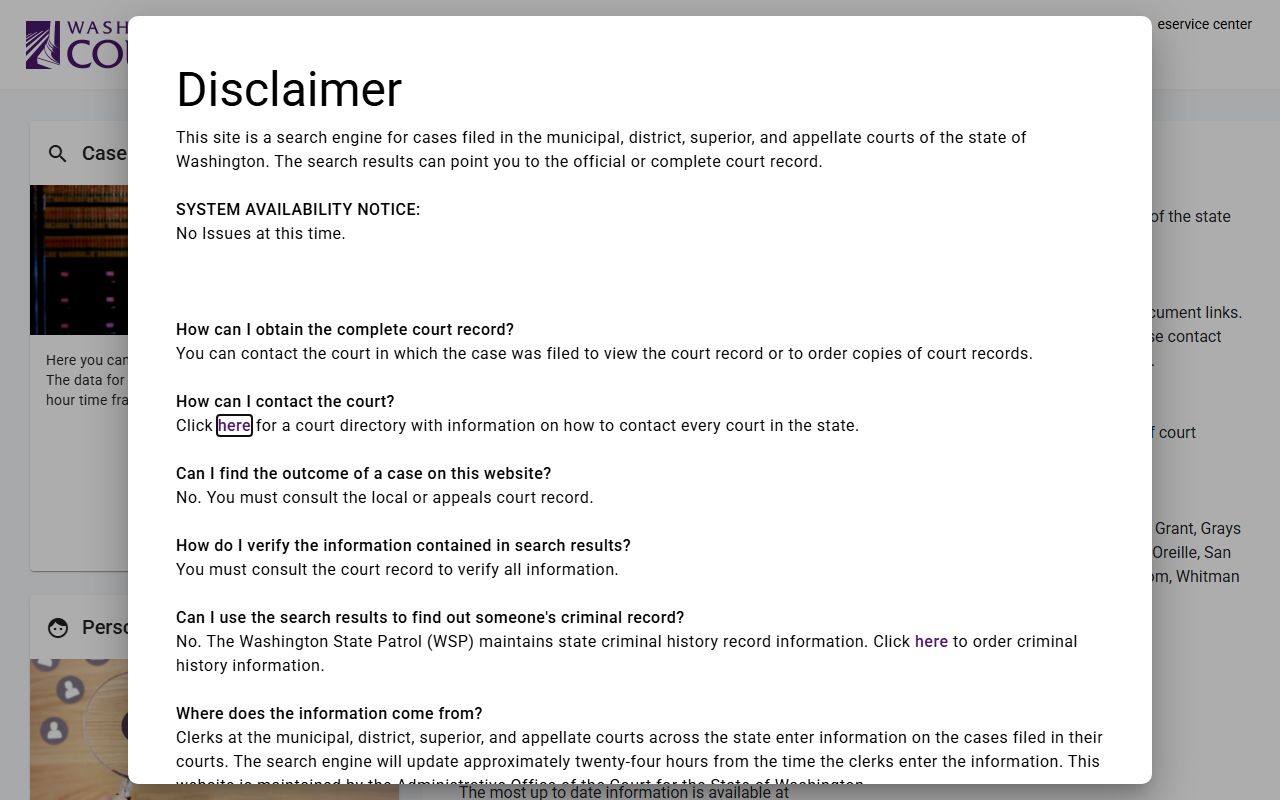
The statewide portal is best treated as an index and court-date aid, while the complete record remains with the court that filed the case.
King County Court Search Fields
King County District Court provides two useful search paths. Name search uses first and last name plus a filing-date range. Case-number search requires the exact case number. The research notes a 365-day limit for filing date ranges in the name search, so a broad name search should be split into smaller date windows when needed.
| Portal | Field | Required | Notes |
|---|---|---|---|
| District Court name search | First Name | Implied | Search with last name and filing date range. |
| District Court name search | Last Name | Implied | Use the name from the booking or court notice. |
| District Court name search | Filing Date | Yes by portal label | Range cannot exceed 365 days. |
| District Court case search | Case Number | Yes | Exact match only. Include dashes if the case number has dashes. |
| Washington Courts | Name, case number, or date | Varies | Use to locate a case and the court contact, not as complete criminal-history proof. |
The District Court criminal and infraction search page is shown at the official King County District Court name search portal.
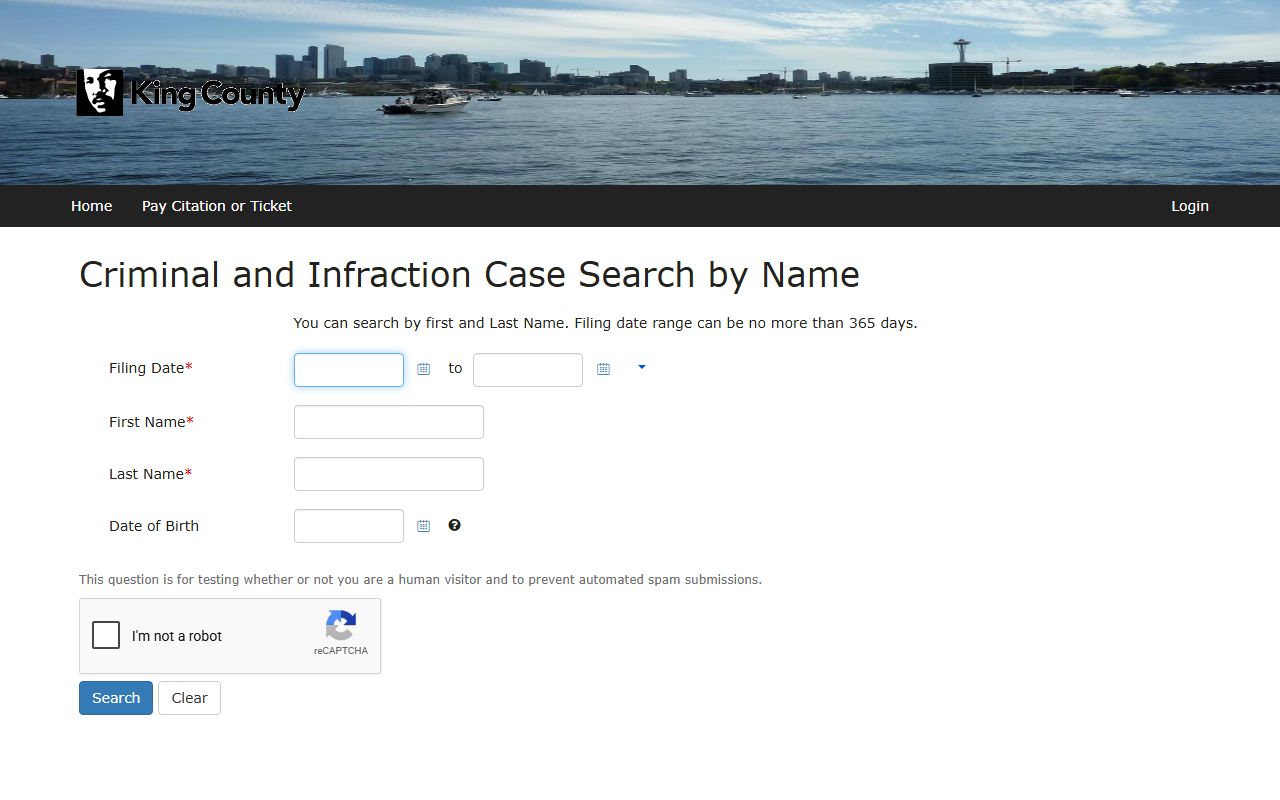
The filing-date field is important because a jail arrest may be visible before the later court filing appears in the portal.
Charging Documents After Arrest
Charges enter court through a charging document. The exact term depends on case type and procedure, but the practical point is the same: the charging document is the court record that states what the prosecutor or grand-jury process put before the court. King County research identifies complaints, informations, indictments, amendments, declined charges, and dismissals as possible outcomes after prosecutor review.
| Document | Common Role | What to Check |
|---|---|---|
| Complaint | Often starts a criminal case or states the accusation in lower-court matters. | Filing date, listed charge, cause number, and next hearing. |
| Information | Common prosecutor-filed charging document for many felony matters. | Offense code, class, counts, and any later amendments. |
| Indictment | Charging document returned through a grand-jury process in serious cases. | Count list, federal or state court, and custody status. |
King County Charge Status
Filed charges can change. Court records after a jail arrest should be read count by count because one count may be pending while another is dismissed or amended. A disposition is the outcome of a charge. A conviction is a court finding or plea, not the same as an arrest. An acquittal means the case resolved in the defendant's favor on that charge.
| Status | Plain Meaning | Why It Matters |
|---|---|---|
| Pending | The charge has been filed but not resolved. | Look for the next court date and current release conditions. |
| Amended | The charge was formally changed after filing. | The original booking allegation may no longer match the active case. |
| Reduced | The charge changed to a lesser offense. | Compare the original count to the amended count and final disposition. |
| Dismissed | The charge ended without conviction on that count. | Other counts may still remain active or resolved differently. |
| Deferred or continued | The court delays final disposition under conditions. | Completion or violation may affect later visibility and outcome. |
Bail Warrants and Arrest Records
Bail in King County is set by the court and paid at DAJD reception windows for adult jail custody. King County accepts cash, cashier's check, and money order at KCCF and MRJC from 7 a.m. to 10 p.m., seven days a week. Cashier's checks and money orders must be payable to King County Department of Adult and Juvenile Detention and include the person's name, B/A number, and sender information. Courts handle refunds after case resolution.
Warrants have their own channels. King County District Court says a person can register for a free e-filing or case access account, search by name or case number, and use its warrant help sheet. The Sheriff's Criminal Warrants Unit under Sheriff Patti Cole-Tindall enforces Superior Court felony and civil arrest warrants and handles prisoner transportation and extradition. A warrant arrest may lead to DAJD, Kent, SCORE, federal, or other custody depending on the issuing court and agency.
- Cash bail
- The full court-set amount is paid through the jail payment window.
- Surety bond
- Release is arranged through a licensed bond agency under separate terms.
- Personal recognizance
- The court releases the person on a promise to appear when money is not required.
- No-bond hold
- Money alone will not release the person because a court or agency hold exists.
- Bench warrant
- A judge-issued warrant, often tied to failure to appear or a violation of a court order.
Charges Convictions and Sealing
Court records after an arrest must distinguish accusations from outcomes. A charge is the legal accusation filed in court. A conviction is the final court result after a guilty plea, verdict, or other conviction event. Public court portals may show both, but a casual search should not be used as a full criminal-history screen.
Charge
A filed accusation based on prosecutor review and probable cause. It shows what was alleged, not the final outcome.
Conviction
A court finding, guilty plea, or other conviction result. It shows the outcome for that count, not just the arrest.
Washington access law also creates limits. RCW 42.56 gives the public a route to request public records, but RCW 42.56.240 protects certain investigative, law-enforcement, and victim-related records. RCW 70.48.100 makes the jail register public while also protecting many records about people in custody. Court restrictions, juvenile rules, and sealed cases can limit what appears online.
Sealed
Public access is hidden or restricted by court rule or order, though some justice agencies may retain limited access.
Expunged or Vacated
Eligible relief can change how the record is treated, but agency records may still need separate correction or review.
Important: Public court lookups are not consumer reports and should not be used for employment, tenant, credit, or insurance screening.