
King County Inmate Population Overview
King County's adult jail system is operated by the King County Department of Adult and Juvenile Detention, known as DAJD. That point matters because the King County Sheriff's Office, led by Sheriff Patti Cole-Tindall, handles law-enforcement work, warrants, transportation, and other police duties, but DAJD runs the adult jails, jail records, visitation, mail, money, bail windows, and population reports. Adult secure detention is centered on two DAJD buildings: King County Correctional Facility in Seattle and Maleng Regional Justice Center in Kent.
The King County inmate population also includes custody paths that do not sit inside the main adult roster. The Judge Patricia H. Clark Children and Family Justice Center handles youth detention. SCORE in Des Moines and the City of Kent Corrections Facility are separate municipal or regional jail systems. Federal Detention Center SeaTac is a federal Bureau of Prisons facility. Sentenced state prisoners from King County are searched through the Washington State Department of Corrections, not through the county roster after transfer.
King County's population reports page is the source for official DAJD Detention and Alternatives Reports. It tracks secure detention, Electronic Home Detention, youth custody, community alternatives, bookings, releases, average daily population, and average length of stay. Those reports are a better source than unsourced jail capacity claims because the captured official DAJD facility pages did not publish rated bed counts for KCCF or MRJC.
King County Inmate Population Statistics
The strongest single measure for the King County inmate population is adult secure average daily population, or ADP. DAJD defines ADP as the average number of people in custody per day, with daily totals calculated across a 24-hour period. The 2025 DAJD Detention and Alternatives Report listed adult secure ADP at 1,411.5 across the adult jails, with 790.3 at KCCF and 621.2 at MRJC. The same annual report counted 17,564 adult secure bookings and 17,024 adult secure releases.
| Measure | Figure | Source / Date |
|---|---|---|
| Adult secure bookings | 17,564 | DAJD 2025 Detention and Alternatives Report |
| Adult secure releases | 17,024 | DAJD 2025 Detention and Alternatives Report |
| Adult secure ADP | 1,411.5 | DAJD 2025 Detention and Alternatives Report |
| KCCF adult secure ADP | 790.3 | DAJD 2025 Detention and Alternatives Report |
| MRJC adult secure ADP | 621.2 | DAJD 2025 Detention and Alternatives Report |
| Adult secure average length of stay | 32.7 days | DAJD 2025 Detention and Alternatives Report |
| Juvenile secure ADP | 54.7 | DAJD 2025 Detention and Alternatives Report |
| FDC SeaTac rated capacity | 1,004 | U.S. DOJ OIG 2025 inspection report |
The 2026 through-May DAJD scorecard listed adult secure ADP at 1,341.4, with 744.8 at KCCF and 596.6 at MRJC. That is a partial-year figure. It should not be read as a final 2026 annual trend until later DAJD scorecards are published.
King County Jail Population Trends
The King County inmate population was nearly flat by adult secure ADP from 2024 to 2025, moving from 1,407.4 to 1,411.5. The flow through the jails changed more than the daily count did. Secure bookings rose from 15,284 in 2024 to 17,564 in 2025, while adult secure average length of stay fell from 38.1 days to 32.7 days. That pattern points to more booking events with shorter average secure stays, not a simple rise in the number of people held each day.
| Year | Adult Secure ADP | KCCF ADP | MRJC ADP | Notes |
|---|---|---|---|---|
| 2024 | 1,407.4 | 788.5 | 618.9 | 15,284 secure bookings; 38.1 day secure ALOS. |
| 2025 | 1,411.5 | 790.3 | 621.2 | 17,564 secure bookings; 32.7 day secure ALOS. |
| 2026 through May | 1,341.4 | 744.8 | 596.6 | Partial-year scorecard; 6,993 secure bookings. |
Youth detention moved differently. DAJD's research data lists juvenile secure ADP at 54.7 in both 2024 and 2025, then 31.2 through May 2026. King County policy debates around the Patricia H. Clark youth facility make that figure locally important, but it should not be blended with adult jail ADP when describing the adult King County inmate population.
Who Is in King County Custody
The King County inmate population is not one legal group. Adult DAJD custody includes people booked on felony matters from throughout the county, misdemeanor bookings for Seattle and many local jurisdictions, people serving court-ordered jail sentences, and people held on warrants or other agency holds. Youth detention is separate. Municipal custody may sit with SCORE or Kent. Federal custody at FDC SeaTac is not county jail custody even when the arrest or court case is tied to Seattle.
- Booking
- The identification, fingerprinting, and intake process when an arrested person is admitted to detention.
- B/A number
- The King County Book of Arrest number used for jail contact, mail, money, and many family support tasks.
- ADP
- Average daily population, DAJD's daily-count measure for detention and alternatives reports.
- DOC custody
- Washington State Department of Corrections custody for sentenced state prisoners after transfer from county jail.
- Detainer
- A hold or request from another agency. Immigration detainers require careful treatment because King County limits civil immigration cooperation.
The county also tracks Electronic Home Detention, Community Center for Alternative Programs, and PALS in population reports. Those alternatives matter for the larger custody system, but they are not the same as a bed in KCCF or MRJC. A search result may even show nontraditional location categories such as Community Correction Division or Electronic Home Detention.
King County Inmate Population Laws
Washington law supports public access to jail and custody records, but it does not make every detail public. The Washington Public Records Act gives people a route to request agency records unless an exemption applies. The jail-specific statute, RCW 70.48.100, makes the jail register public while also treating many records about confined people as confidential unless criminal justice use, a court order, or another law allows release.
Key Washington custody laws:
RCW 42.56 creates the public-records request path for Washington agency records.
RCW 42.56.240 protects certain law-enforcement, investigative, and victim-related material from release.
RCW 36.28A.040 requires a statewide city and county jail booking and reporting system.
RCW 70.48.400 helps separate jail sentences from state DOC commitments when sentence length crosses the state-prison line.
Booking photos and fingerprints have their own rule. RCW 43.43.735 requires photographing and fingerprinting for adults and juveniles lawfully arrested for felony or gross misdemeanor offenses. That does not mean every booking photo is displayed online. King County records pages still cite confidentiality and exemption limits for many records about people in custody.
Search King County Inmate Population
The official adult jail search channel is the King County DAJD Subject Lookup Tool. It covers adults who have been at King County jails during the last year. The county's locate-a-person page says the tool can identify whether an adult is currently in custody, where the person is held, and the B/A number. The same King County locate page gives 206-296-1234 as the adult jail phone fallback.
The search starts broad. Use the last name first, add first name and date of birth when the name is common, and choose Currently In Custody when the goal is a current jail resident. Avoid over-filtering by facility unless the location is known. The facility menu includes adult jails, youth detention, court and community custody categories, and alternatives, so a too-narrow search can miss a real record.
- Open the DAJD Jail Lookup Service or go directly to the public Subject Lookup form.
- Search by last name, then add first name or date of birth to narrow common names.
- Use the in-custody filter for a current King County jail roster search.
- Check the result for location, booking time, investigation reason, bail, and B/A number where shown.
- If no record appears, call the adult jail line, then check SCORE, Kent, Washington DOC, BOP, or ICE based on the custody facts.
The Subject Lookup Tool is a custody and booking source. It is not proof of conviction. The King County Open Data jail bookings dataset covers adult bookings within the last 12 months and warns that it is not a court cause, court case, criminal filing source, criminal history, or criminal status record.
King County Roster Screen
The DAJD public Subject Lookup form shows why name, date of birth, custody status, and facility filters should be used with care.
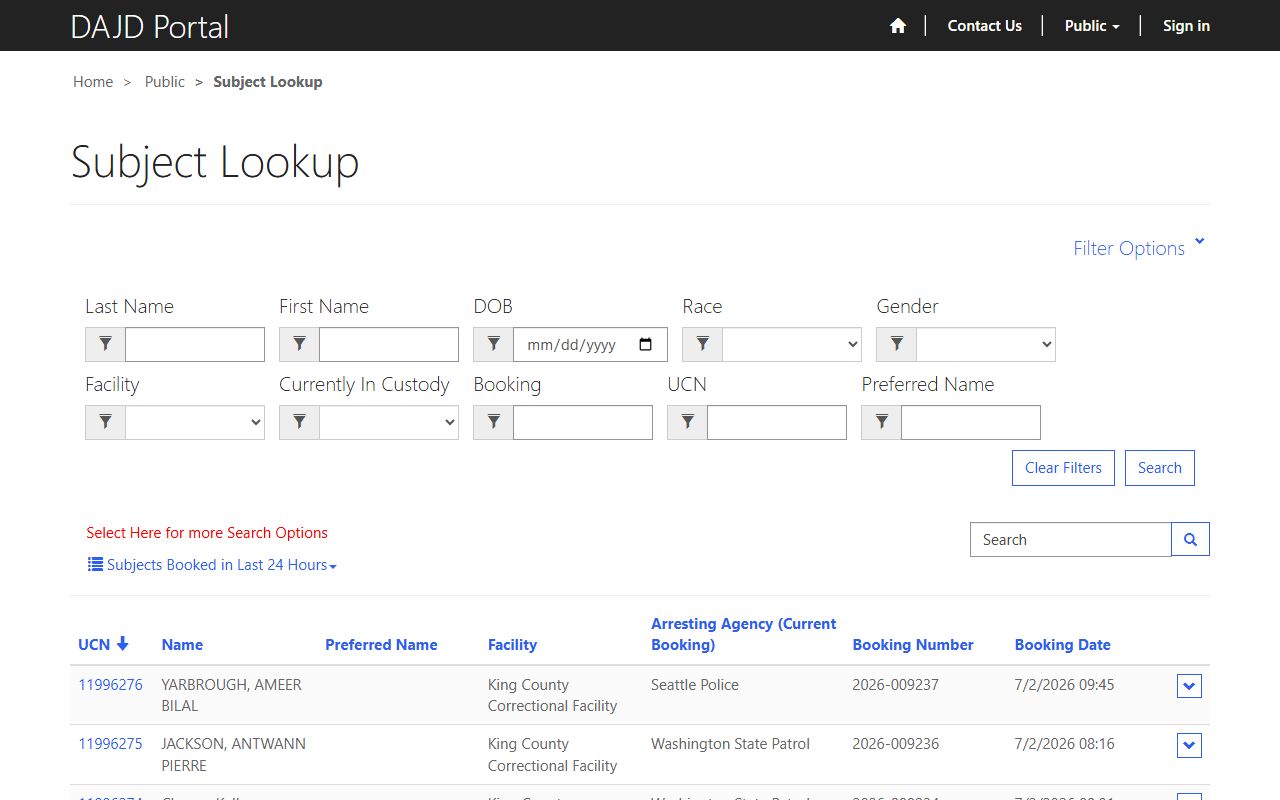
The visible form includes Last Name, First Name, DOB, Race, Gender, Facility, Currently In Custody, UCN, Preferred Name, and booking-related labels. Public access is available, but the portal also displays permission and no-record messages for some views.
King County Roster Search Fields
King County's Subject Lookup fields are more detailed than a simple last-name jail list. Race and gender filters can narrow a broad name. Facility choices can help when a caller already knows whether the person is at KCCF or MRJC. The tool's public labels do not state which fields are required, so a conservative search starts with fewer filters and adds detail only when the result set is too broad.
| Field Label | Type | Required | Notes |
|---|---|---|---|
| Last Name | Text | Unspecified | Best first search field; no wildcard rule was captured. |
| First Name | Text | Unspecified | Use to narrow common surnames. |
| DOB | Date/text | Unspecified | Date format was not stated in the captured page. |
| Race | Dropdown/list | Unspecified | Includes American Indian, Asian, Black, Hispanic, Other, Unknown, and White. |
| Gender | Dropdown/list | Unspecified | Includes Male, Female, X, and Unknown. |
| Facility | Dropdown/list | Unspecified | Includes KCCF, MRJC, CCFJC, court, community, and alternative locations. |
| Currently In Custody | Radio/dropdown | Unspecified | Use Yes for a current county jail roster search. |
| UCN / Preferred Name | Text | Unspecified | Visible booking-related fields; acronym expansion was not captured. |
King County Inmate Record Fields
A King County inmate record should be read as a jail custody record. The public county sources say the lookup can show current custody, facility location, B/A number, booking time, investigation reason, and whether bail has been set. The roster may be enough to contact someone in jail or send money, but court portals are still needed for filed charges, case status, hearings, and disposition.
| Field | What It Means |
|---|---|
| Name and preferred name | Identity fields used to find or confirm the record. |
| Facility/location | The custody site or program category shown by DAJD. |
| Current custody status | Whether the person is presently held in the covered county system. |
| Booking/B/A number | The Book of Arrest number needed for contact, money, and many jail tasks. |
| Booking time/date | When the person was admitted to jail custody. |
| Investigation or booking charge | The arrest or booking description, not the final court outcome. |
| Bail | Whether bail has been set, when the public record shows it. |
Note: A booking charge can differ from the prosecutor-filed charge that appears in court records after a jail arrest.
King County Jail vs Prison Search
The correct search site depends on legal custody. County jail lookup covers pretrial custody, local jail sentences, some warrants, and recent county bookings. The Washington DOC locator covers sentenced state prisoners after transfer. BOP covers federal inmates from 1982 to present. ICE ODLS covers immigration custody. A person can move from one system to another as the case changes.
| Custody Type | Where to Search | What It Covers |
|---|---|---|
| King County adult jail | DAJD Subject Lookup | KCCF and MRJC adults, current and last-year custody coverage. |
| Sentenced state prison | Washington DOC Incarcerated Search | Current state DOC incarceration, location, DOC number, and VINE links. |
| Federal custody | BOP Inmate Locator | Federal inmates from 1982 to present, including FDC SeaTac where applicable. |
| Immigration custody | ICE Online Detainee Locator System | Immigration detainee searches by A-Number/country or biographic data. |
| Victim notification | Washington VINE | Custody status notifications for release, transfer, or escape events. |
King County Detention Facilities
The King County inmate population is split across county, city, regional, juvenile, and federal systems. A failed DAJD search does not always mean the person is not in custody. It may mean the person is in a separate municipal jail, a federal facility, a youth detention status line, or a state prison locator after sentencing.
- King County Correctional Facility holds adult county jail residents in downtown Seattle and is the primary DAJD adult jail.
- Maleng Regional Justice Center is the Kent adult DAJD jail and courthouse complex for south county custody.
- Judge Patricia H. Clark Children and Family Justice Center handles youth detention and juvenile court services.
- South Correctional Entity Regional Jail serves municipal custody for Auburn, Burien, Des Moines, Renton, SeaTac, and Tukwila.
- City of Kent Corrections Facility is a separate Kent municipal jail with its own lookup and booking practices.
- Federal Detention Center SeaTac is a BOP federal detention center for federal pretrial, holdover, sentenced, and federal-agency custody.
King County Jail Records Requests
When the online King County jail roster does not show enough detail, use the DAJD records request page. King County prefers GovQA. Inmate records go through the Incarceration Records tile, while broader jail operations records use the Jail Operations Records tile. Requests can also be started by email at records.DAJD@kingcounty.gov, by phone at 206-477-5130, or by mail to Records Request, 500 5th Avenue, Seattle, WA 98104.
Records staff need a way to respond. King County says a request should include a call back number, email address, or mailing address. If a person sends a request by phone, email, or mail, the county creates a GovQA account for that requester. Washington records law may still allow redaction or withholding where confidentiality, investigations, victim information, or jail-record limits apply.
King County Jail Contact Steps
After a King County inmate lookup, the B/A number becomes the key practical detail. Non-legal mail for adult jail residents goes through Securus Digital Mail Center in Tampa with the person's full name and 10-digit booking number. Legal mail and publications go directly to KCCF or MRJC. Adults in King County jail get two free phone calls per week, with added Securus calls at 5 cents per minute. Incoming calls are not allowed.
Money goes through Access Corrections online, mobile app, kiosks, retail cash deposit, phone deposit, mailed money order or cashier's check, or Access Securepak care packages. Bail is separate. King County accepts bail at KCCF and MRJC reception windows from 7 a.m. to 10 p.m. with cash, cashier's check, or money order. Scams are a documented risk, so family members should verify release, Electronic Home Detention, and bail demands through official jail customer service before paying anyone.
King County Inmate Population FAQ
How large is the King County inmate population? DAJD's 2025 Detention and Alternatives Report listed adult secure ADP at 1,411.5, with 790.3 at KCCF and 621.2 at MRJC. The 2026 through-May scorecard listed a lower partial-year adult secure ADP of 1,341.4.
How do I search King County inmates? Use the DAJD Subject Lookup Tool for adult KCCF and MRJC custody. If the person is not found, call 206-296-1234 and check SCORE, Kent, Washington DOC, BOP, ICE, or VINE as the facts require.
Does the King County jail roster prove conviction? No. The roster and open bookings data are custody and booking sources. Court records show filed charges, hearings, disposition, and conviction status.
Where are youth detention records checked? Youth detention is not treated like the adult roster. Families use the Judge Patricia H. Clark Children and Family Justice Center status line at 206-263-9595.