
Clark Youth Detention Overview
Judge Patricia H. Clark Children and Family Justice Center, also called CCFJC, is not an adult jail. It is a combined youth detention, juvenile court, and family justice facility in Seattle's Central District. King County's research sources identify the detention operator as the Department of Adult and Juvenile Detention Juvenile Division, while the building also serves King County Superior Court functions. Youth detention is used for serious or violent allegations and high-risk circumstances, and the county says youth attend school and receive programs while detained.
The distinction from adult custody is critical. KCCF and MRJC are adult jails searched through the King County Subject Lookup Tool. Youth detention has a protected path, and families should call the 24-hour youth detention and court-date status line rather than assuming that a juvenile will appear in an adult-style jail roster. Some youth may have cases in juvenile court, while some older youth or case types may involve adult superior court jurisdiction. The custody process still does not become an adult jail lookup by default.
The official Superior Court location page gives public building details for the center. The Children and Family Justice Center source page is the matching source for the facility image below.
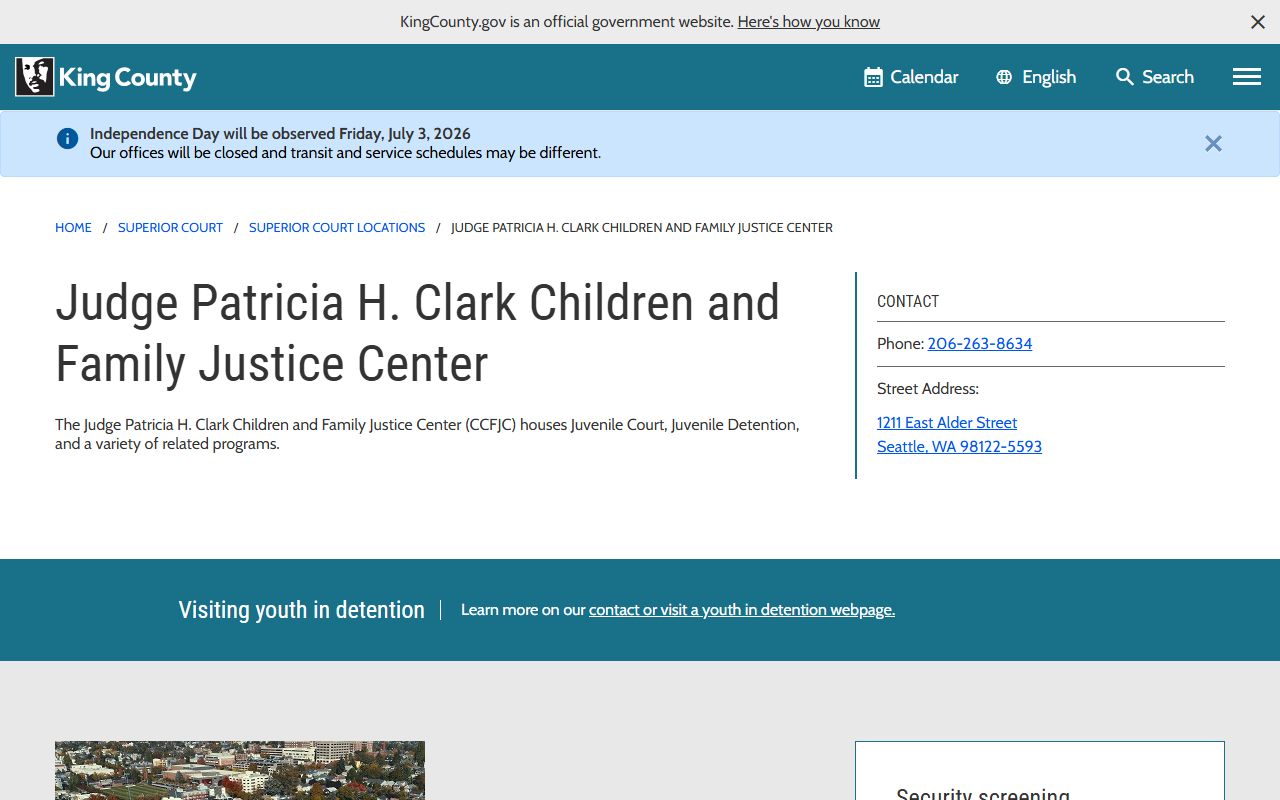
The source page is useful for public access, address, building hours, parking, and transit details, while youth custody status still goes through the detention line.
Clark Center Youth Custody Status
For youth under 18, King County's research points families to the youth detention status line at 206-263-9595, available 24 hours a day, seven days a week. DAJD's youth page also lists youth detention phone 206-263-5992, and the Superior Court location page lists the building phone as 206-263-8634. The safest first question is whether the caller needs detention status, a court date, building access, or a court-office question. Those are related, but they are not the same service.
- Call 206-263-9595 for youth detention or court-date status.
- Use the youth's full legal name and date of birth if staff ask for identifiers.
- Ask whether the issue is detention status, court scheduling, family visitation, or building access.
- Follow staff instructions on parent, guardian, attorney, or approved-contact rules.
- Use adult DAJD lookup only when official staff confirm the person is in an adult jail process.
| Contact Path | Number | Use |
|---|---|---|
| Youth detention status line | 206-263-9595 | 24/7 youth detention and court-date status. |
| Youth detention phone | 206-263-5992 | DAJD youth detention questions. |
| Building / court location phone | 206-263-8634 | Superior Court location and building information. |
| Adult jail information | 206-296-1234 | Adults at KCCF or MRJC only. |
King County Youth Detention Population
King County publishes juvenile secure detention statistics in DAJD Detention and Alternatives Reports. The captured 2025 scorecard lists juvenile secure ADP at 54.7, with 572 juvenile secure admissions for the year. Through May 2026, juvenile secure ADP dropped to 31.2, with juvenile-court jurisdiction ADP at 26.9 and adult-court jurisdiction youth ADP at 4.3. These figures describe the youth secure detention population as a whole, not a public list of individual youth.
| Measure | Figure | Source |
|---|---|---|
| Juvenile secure ADP | 54.7 | DAJD 2025 Detention and Alternatives Report |
| Juvenile secure admissions | 572 | DAJD 2025 report |
| Juvenile secure ADP | 31.2 | DAJD 2026 through May scorecard |
| Adult-court jurisdiction youth ADP | 4.3 | DAJD 2026 through May scorecard |
Clark Center Address Contact
The center is at 1211 East Alder Street in Seattle. The Superior Court location page lists public building hours from 8:30 a.m. to 4:30 p.m. and a midday closure from 12:15 p.m. to 1:15 p.m. Building access is listed from 7 a.m. to 5 p.m. Monday through Friday. These hours are for public building access and court-location services. Detention status for a youth should still be handled through the 24/7 youth status line.
Judge Patricia H. Clark Children and Family Justice Center
1211 East Alder Street
Seattle, WA 98122-5593
206-263-8634
Building hours 8:30 a.m. to 4:30 p.m.; midday closure 12:15 p.m. to 1:15 p.m.
Youth Detention Status
King County DAJD Youth Detention
Seattle, WA
206-263-9595
24 hours a day, seven days a week.
Clark Center Family Visits
Youth detention visits and contact rules differ from adult jail rules. The adult KCCF and MRJC rules about one-hour weekly visits, adult jail housing schedules, and Securus video visits should not be applied automatically to CCFJC. King County research says parents and guardians should use the youth detention page and the youth status line for contact and visit instructions. Youth cases have privacy, school, safety, and family-status issues that make direct phone confirmation more important than a public roster page.
| Visit Topic | Clark Center Approach | Why It Differs |
|---|---|---|
| Parent or guardian contact | Confirm through youth detention staff | Youth rules are not adult jail visitor rules. |
| Status and court date | Call 206-263-9595 | Line is available 24/7 for youth status. |
| Building entry | Use public building hours and security rules | Court access and detention access are separate. |
| Adult visits | Not the default path | KCCF and MRJC procedures are adult jail procedures. |
Clark Center Directions Parking
King County's youth detention directions place the facility near Seattle University in the Central District. From I-5 north or south, the county route uses James Street east, then a right turn on 12th Avenue. The facility is on the east side. Public parking is available in a garage off 12th Avenue, and the DAJD youth page says temporary free parking on the top level can be validated inside. The Superior Court location page also notes nearby public transit, including Metro routes 3 and 4, and bike parking near the main entrance.
Families should account for courthouse security, parking time, and the midday building closure when planning a visit or hearing. A court appearance, detention visit, school contact, and attorney meeting can each have a different path inside the same building.
Clark Center Youth Services
King County says youth in detention attend school and have access to programs and services. The county's youth detention page frames the detention center around rehabilitation and community safety, not just confinement. The King County Council's August 27, 2024 release also described the facility as including modern classrooms, a library, a gym, and a medical clinic in the same building as community services and juvenile courtrooms. That same release said the facility opened in 2020 and cost $242 million.
The service model is one reason the Clark center should not be described like a standard adult jail. A youth's day can involve school, family contact, court obligations, health services, and detention supervision inside the same campus. Public information is therefore more limited and more routed than adult booking data. Families, lawyers, and approved contacts should use the youth detention line and court instructions instead of trying to infer status from adult custody tools.
- Juvenile detention
- Secure custody for youth under court authority, used for serious or violent allegations or high-risk circumstances.
- Juvenile-court jurisdiction
- A youth case handled in juvenile court rather than through ordinary adult criminal court.
- Adult-court jurisdiction youth
- A youth held in secure detention while a case proceeds under adult superior court authority.
- EHM
- Electronic Home Monitoring, an alternative tracked separately from secure detention in DAJD reports.
Clark Center Policy Context
Youth detention policy has been an active King County issue. The County Council's August 2024 release said the original goal had been to close the juvenile detention facility by 2025, but the anticipated closure date was revised to at least 2028. That policy debate should not be confused with day-to-day custody status. Families still need the current youth status line, court-date information, and instructions from detention or court staff for a specific youth.
For adults in King County custody, use KCCF, MRJC, and the Subject Lookup Tool. For youth custody at CCFJC, use the youth-specific contacts and avoid public adult roster assumptions. For sentenced state-prison custody after a felony sentence, use the Washington DOC incarcerated search. Each system answers a different custody question.
King County's population reports also separate juvenile secure detention from electronic home monitoring and adult secure jail custody. That separation is important for readers comparing figures across facilities. A youth secure ADP number is not part of the KCCF or MRJC adult jail count, and it should not be used as a roster substitute.
Note: Confirm youth custody and visit rules with King County youth detention staff before traveling to the Clark center.